
Key Takeaways
- Agentic AI is goal-driven intelligence that takes autonomous actions, not just recommendations, reducing operational effort by 30-60%
- It differs from automation: Traditional automation follows rules; agentic AI sets goals, plans steps, and adapts based on results.
- Real business impact: Companies achieve 42% faster incident resolution and 35% cost reduction within 90 days
- How it works: A 5-layer architecture (Goal → Plan → Orchestrate → Execute → Learn) enables continuous optimization without human intervention
- Adoption is accelerating: IT services, SaaS, finance, and customer support are leading implementation in 2025-2026
- Key challenge: Balancing AI autonomy with human oversight through proper governance frameworks
Why Everyone Is Talking About Agentic AI
AI has been the new norm to work with. The years 2023 and 2024 were about experimenting with AI and 2025 was about scaling it, now is about letting AI act on its own. That is where agentic AI and autonomous AI come in.
Unlike traditional AI tools that wait for instructions, agentic AI systems set goals, make decisions, take actions, and learn from outcomes without minimal human instructions. For IT services companies, SaaS platforms, and enterprises, this shift is redefining productivity, cost optimization, and service delivery.
What Is Agentic AI?
Agentic AI refers to AI systems designed as agents that can:
- Understand goals
- Break goals into tasks
- Choose tools and data
- Execute actions autonomously
- Monitor results and adapt
Many agentic AI systems are built on generative AI foundations, using LLMs for reasoning and natural language understanding.
Let’s understand this with an example –
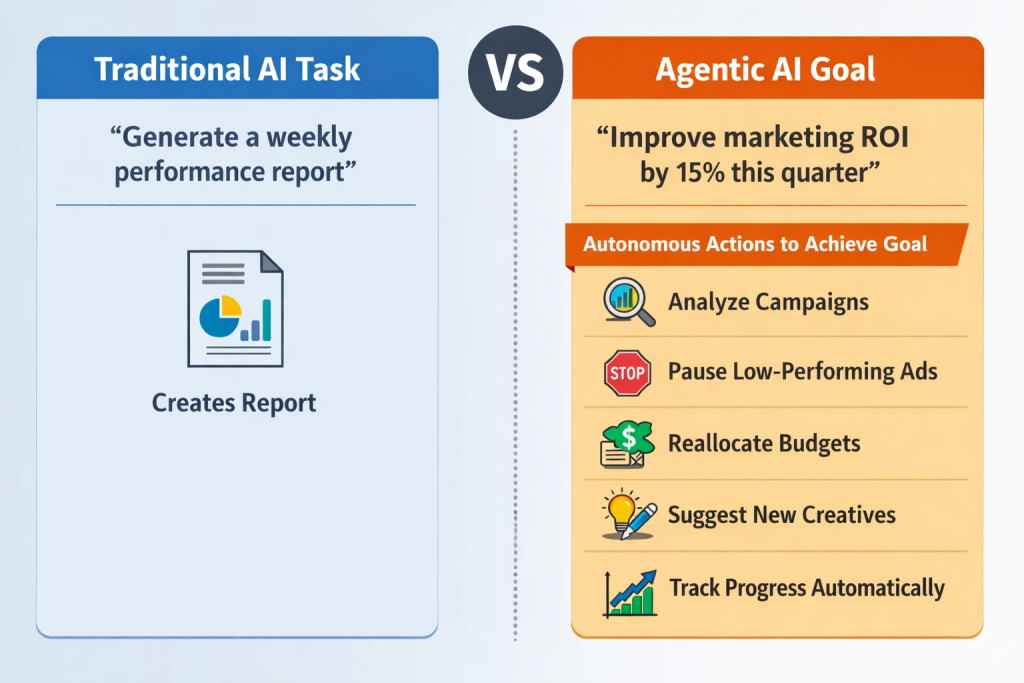
Instead of asking AI: Generate a weekly performance report
You’ll ask: Improve marketing ROI by 15% this quarter
An agentic AI system will:
- Analyze campaigns
- Pause low-performing ads
- Reallocate budgets
- Suggest new creatives
- Track progress automatically
What Is Autonomous AI?
Autonomous AI is the broader concept where AI systems operate independently over time, making decisions without continuous human input.
Key Difference between Agentic AI and Autonomous AI
| Agentic AI | Autonomous AI |
| Focuses on goal-driven agents | Focuses on independent operation |
| Task + decision-oriented | End-to-end system control |
| Often modular | Often system-wide |
| Common in workflows | Common in operations |
Why Agentic AI Matters for Businesses
Agentic AI aligns perfectly with real business impact which is why it’s dominating IT conversations.
Key Business Benefits
- 30-60% reduction in operational effort
- Faster decision-making
- Always-on optimization
- Scalable service delivery
- Reduced human error
Industries that are adopting it fastest:
- IT services SaaS & cloud platforms
- Finance & fintech
- Customer support
- HR & recruitment
- Marketing & performance teams
How Agentic AI Works: Architecture Explained
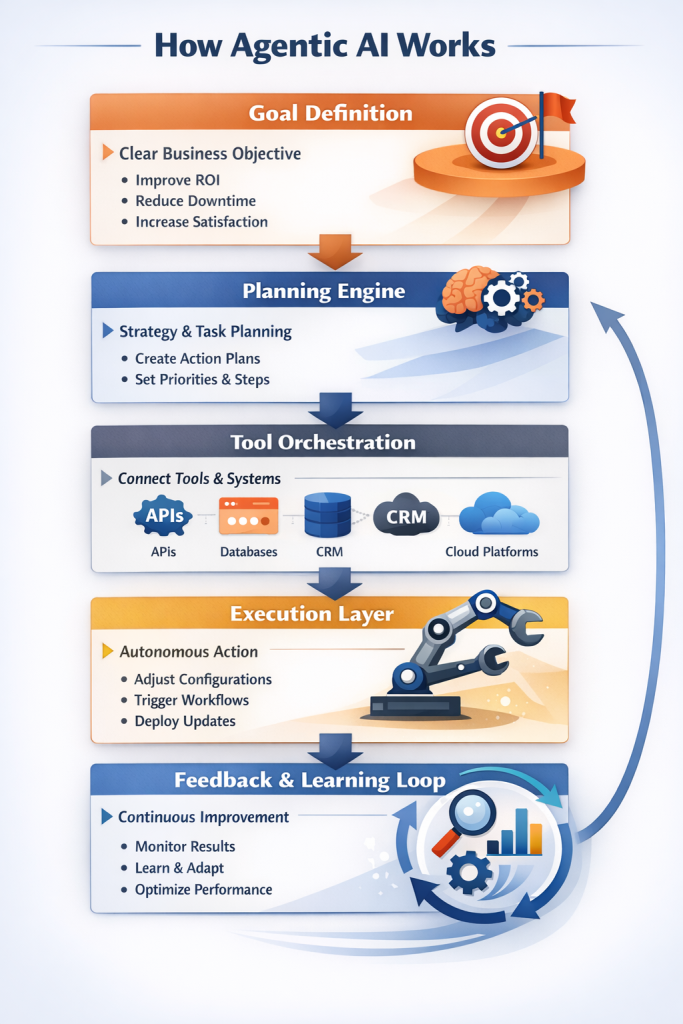
Agentic AI operates through a structured, goal-driven architecture that allows it to plan, act, and continuously improve. Unlike reactive AI systems, this architecture enables independent decision-making and execution.
1. Goal Definition Layer
Everything starts with a clearly defined business objective or system goal.
Instead of assigning tasks, organizations define outcomes such as improving ROI, reducing downtime, or increasing customer satisfaction.
2. Planning Engine
The planning engine converts high-level goals into actionable, executable steps.
It evaluates multiple strategies, prioritizes tasks, and determines the best sequence of actions required to achieve the defined goal.
3. Tool Orchestration Layer
At this stage, the AI agent selects and connects with the required tools and systems, including:
- APIs
- Databases
- CRMs
- Cloud platforms
- Analytics and monitoring tools
This layer enables seamless coordination across the enterprise tech stack.
4. Execution Layer
The execution layer is where agentic AI truly differentiates itself.
Instead of offering recommendations, it takes real actions, such as adjusting configurations, triggering workflows, reallocating resources, or deploying updates all within predefined governance limits.
5. Feedback & Learning Loop
Every action generates outcomes that are continuously monitored.
The system analyzes results, learns from successes and failures, and refines future decisions automatically to improve performance over time.
Why This Architecture Matters
This continuous goal > plan > act > learn loop is what makes agentic AI proactive and adaptive, rather than reactive. It enables AI systems to operate independently, optimize outcomes, and scale decision-making across complex business environments.
A modern agentic AI system includes:
- Goal Definition Layer
Business objectives or system goals - Planning Engine
Breaks goals into executable steps - Tool Orchestration
APIs, databases, CRMs, cloud tools - Execution Layer
Takes real actions (not just suggestions) - Feedback & Learning Loop
Improves decisions over time
This loop is what makes AI agentic instead of reactive.
Real-World Case Study: Agentic AI in IT Services
The following example illustrates how agentic AI can transform IT operations in practice. This scenario is based on a typical mid-sized IT services company facing common industry challenges.
Client Background
A mid-sized IT services company offering:
- Cloud support
- DevOps
- Managed infrastructure
Challenges
- Slow incident resolution
- Manual ticket triaging
- High dependency on senior engineers
- Rising operational costs
The Solution: Agentic AI Deployment
An agentic AI system was implemented to manage IT operations.
What the AI Agent Did:
- Monitored system logs in real-time
- Detected anomalies
- Categorized incidents automatically
- Triggered predefined remediation scripts
- Escalated only complex issues to humans
Results (Within 90 Days)
- 42% reduction in incident response time
- 35% drop in operational costs
- 99.9% system uptime
- Higher client satisfaction scores
This wasn’t automation. This was autonomous decision-making at scale.
Traditional Automation vs Agentic AI
Many businesses confuse automation with autonomy.
| Traditional Automation | Agentic AI |
| Rule-based | Goal-based |
| Static workflows | Dynamic planning |
| Human-triggered | Self-initiated |
| No learning | Continuous learning |
Challenges & Ethical Considerations
Agentic AI isn’t plug-and-play.
Key challenges:
- Governance & control
- AI accountability
- Data quality
- Security & access permissions
The Future of Agentic & Autonomous AI
Over the next 2–3 years, we’ll see:
- AI agents managing entire departments
- Autonomous customer success platforms
- Self-optimizing SaaS products
- AI-led DevOps & SecOps
Agentic AI won’t replace humans it will replace hesitation, inefficiency, and manual overload.
Conclusion
Agentic AI and autonomous AI represent the next evolution of enterprise intelligence. They don’t just respond they act, adapt, and optimize.
For IT services companies and digital-first businesses, this shift isn’t optional anymore. It’s the difference between scaling with people or scaling with intelligence. If you’re building for the future, you’re building with agentic AI.

Anil Sharma is the founder of Zasya Solutions, where he leads the product and engineering teams in building reliable web and mobile solutions.